
TORC (Torque Operated Rotor Control) Technology

U.S. Patent 12,134,467 · Flight Proven · Electron Flight LLC

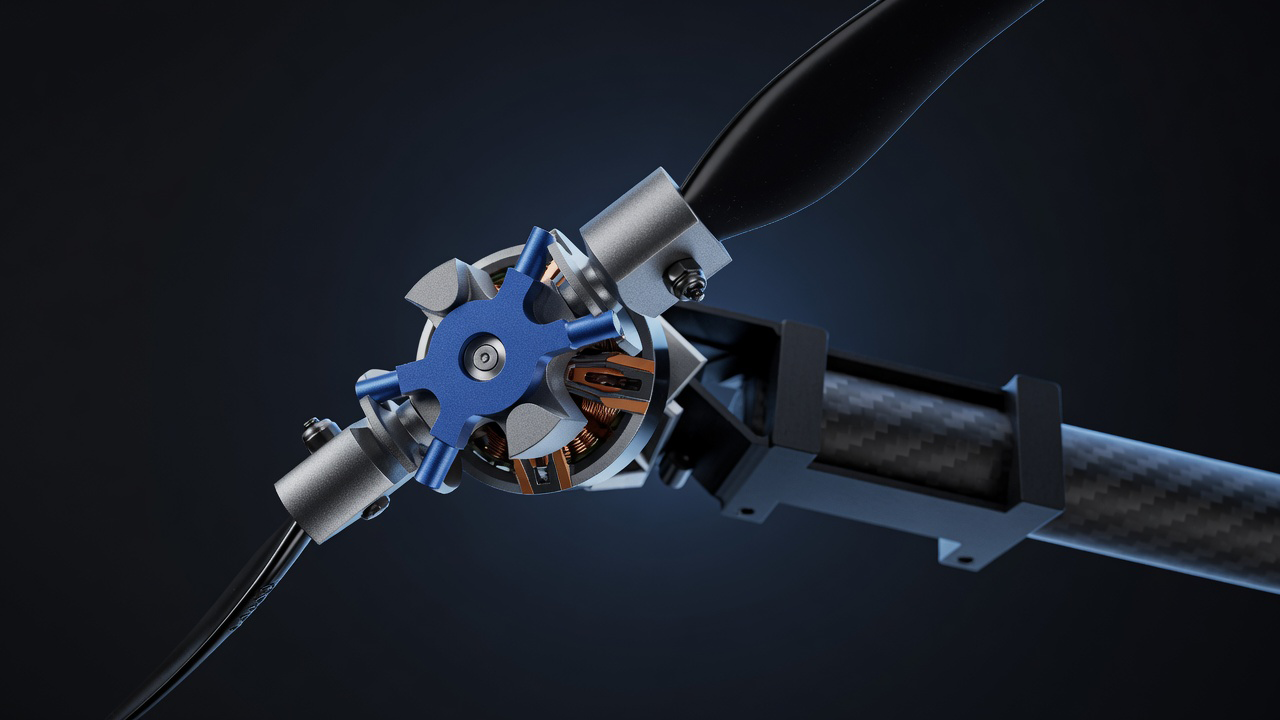
Tiltrotor capability without the tiltrotor complexity. TORC technology tilts the rotor and changes blade pitch using nothing but the drive motor's own torque. There are no tilt actuators, pitch actuators, linkages or complex mechanisms.

Each nacelle has two stable states. Spinning the motor one way puts the nacelle in hover position with fine blade pitch. Reversing the motor uses the rotor's reaction torque to swing the nacelle into cruise position with coarse blade pitch. Mechanical stops define both positions.
  • Rotor tilt and blade pitch driven by motor torque alone
  • No tilt actuators, pitch actuators or linkages
  • Two torque modes: hover (fine pitch) and cruise (coarse pitch)
  • Mode change by reversing motor direction at low power
  • Smooth, gradual transitions by sequencing individual nacelles
  • Multiple flying prototypes, full hover-to-cruise transition demonstrated
  • Fewer parts, lower cost, higher efficiency, higher reliability
  • Simpler versions can use a bidirectional fixed-pitch propeller

Hover Mode

  • Motor turns in its first direction
  • Rotor torque holds the nacelle against its hover stop
  • Blades sit at fine pitch for efficient vertical lift
  • Thrust points down for VTOL and hover
TORC rotor hub and nacelle on a carbon-fiber arm

Cruise Mode

  • Motor direction is reversed
  • Reaction torque swings the nacelle to its cruise stop
  • Blades shift to coarse pitch for efficient forward flight
  • Thrust points rearward for wing-borne cruise

Sequenced Transition

  • Each nacelle is binary: hover or cruise
  • Nacelles or coordinated pairs change mode one step at a time
  • More rotors give more in-between steps and a smoother transition
  • Eight rotors balance smoothness with easy airframe integration

TORC vs. Conventional Tiltrotor

FeatureConventional tiltrotorTORC technology
Nacelle tiltTilt actuator, gearbox and linkage per nacelleMotor's own reaction torque against fixed stops
Blade pitchPitch actuator or swashplate per rotorPitch set by torque direction: fine for hover, coarse for cruise
Mode changeActuator-driven sweepReverse motor direction at low power
Parts per nacelleMotor, tilt actuator, pitch actuator, linkages, bearingsMotor, rotor, pivot and stops
Failure pointsActuators, linkages, wiring to actuatorsFar fewer moving parts
Transition smoothnessContinuous tilt angleSequenced binary nacelles; smoother with more rotors
CostHighLow

What TORC Technology Makes Possible

Benefits

  • Fewer parts: No tilt or pitch actuators, linkages or swashplates.
  • Lower cost: Simpler nacelles are cheaper to build and maintain.
  • Efficiency: Fine pitch for hover and coarse pitch for cruise, each matched to its flight phase.
  • Reliability: Fewer moving parts and failure points; each nacelle rests on mechanical stops.

Applications

  • eVTOL and advanced air mobility: Distributed-rotor tiltrotors with simpler nacelles.
  • Uncrewed aircraft: VTOL fixed-wing drones that need range and simplicity.
  • Retrofit: Eight-rotor layouts that integrate onto existing airframes.
  • RC and research platforms: Low-cost tiltrotor testbeds.

How TORC Technology Works

  • Torque-operated nacelle: The rotatable nacelle pivots on a fixed nacelle. The motor shaft is set at an angle to the pivot axis, so rotor reaction torque drives the nacelle to one of two stops depending on motor direction.
  • Two torque modes: Reversing motor direction reverses the torque and moves the nacelle between hover and cruise.
  • Variable pitch: Pivoting blades take fine pitch in one direction and coarse pitch in the other. Simpler versions use a bidirectional fixed-pitch propeller.
  • Fast, low-power mode change: In mass-balanced nacelles, tilt and pitch change at minimum motor idle speed within about one rotation.
  • Why eight rotors: Each nacelle has two positions, so more rotors give smoother, more gradual transitions. Eight integrates easily on existing airframes.
  • Flight control: The flying prototypes use a custom flight controller. Integration with an open-source autopilot is in development.

Each TORC nacelle mounts to a fixed boom through a single hinge skewed at 45° to the boom. Motor torque swings the nacelle about this hinge, moving it between hover and cruise without separate tilt actuators.

Line drawing of a TORC nacelle on a fixed boom, with the dashed hinge axis running at 45 degrees through the joint and an arrow showing the swing about it.
Hinge axis: the nacelle swings about a fixed hinge set at 45° to the boom.

In hover the nacelle holds the rotor disc horizontal. Reversing the motor's torque swings the nacelle about the skewed hinge, which turns the rotor to face forward for cruise.

Side-view line drawing in hover: the nacelle sits below the fixed boom with the rotor disc horizontal, and the dashed 45-degree hinge axis passes through the joint.
Hover: rotor disc horizontal.
Side-view line drawing in cruise: the nacelle has swung about the 45-degree hinge so the rotor disc faces forward, while the boom stays fixed.
Cruise: the nacelle has swung about the hinge to face forward.

Proven in Flight

  • Multipleflying prototypes
  • Fullhover-to-cruise transition
  • Zerotilt or pitch actuators
  • First prototype: a TORC bench test stand demonstrating mode change by reversing motor direction
  • TORC technology has since been integrated into several flying platforms
  • Prototypes have flown the full transition from hover to forward flight and back, using a custom flight controller
  • Next: integration with an open-source autopilot is in development

R&D Roadmap

  1. Phase 1 — Open-source autopilot integration (ongoing): Integration with an open-source autopilot is in development for eight-rotor aircraft.
  2. Phase 2 — Instrumented flight testing: Characterize transition smoothness, efficiency and power in hover and cruise.
  3. Phase 3 — Reliability and fault behavior: Motor-out cases, repeated mode cycling, durability.
  4. Phase 4 — Scale-up: Larger nacelles and rotors toward eVTOL and uncrewed aircraft classes.
  5. Phase 5 — Partner integration: Integrate TORC onto partner airframes.

Intellectual Property

U.S. Patent 12,134,467 · Assigned to Electron Flight LLC

FAQ

How does TORC tilt a rotor without an actuator?

The motor shaft sits at an angle to the nacelle pivot, so the rotor's reaction torque swings the nacelle until it reaches a stop. Reversing the motor reverses the torque and swings it back.

How does blade pitch change?

The blades pivot with torque direction: fine pitch in hover mode, coarse pitch in cruise mode.

If each nacelle has only two positions, how is transition smooth?

Nacelles change mode one at a time or in pairs. With eight rotors there are enough steps for a smooth, gradual transition.

Has TORC flown?

Yes. Multiple prototypes have flown, including the full hover-to-cruise transition.

Why eight rotors?

More rotors give smoother, more gradual transitions, and eight integrates easily on existing airframes.

Advance TORC Technology With Us

We're seeking agency, research and industry partners to scale flight-proven TORC technology toward eVTOL and uncrewed aircraft.